
Find out more here.
Find out more here.
In this 5th biannual Girard lecture, organized by the Dutch Girard Society, Nidesh Lawtoo steps back to the insights that, as of 2016, lead him to use the term “(new) fascism” as a warning against Donald Trump’s anti-democratic tendencies, which culminated in an insurrection on January 6. Despite many critical warnings and fascist actions, the efficacy of the affective and infective powers of mimesis never ceases to surprise. Hence, the urgency of new mimetic studies. More information HERE.
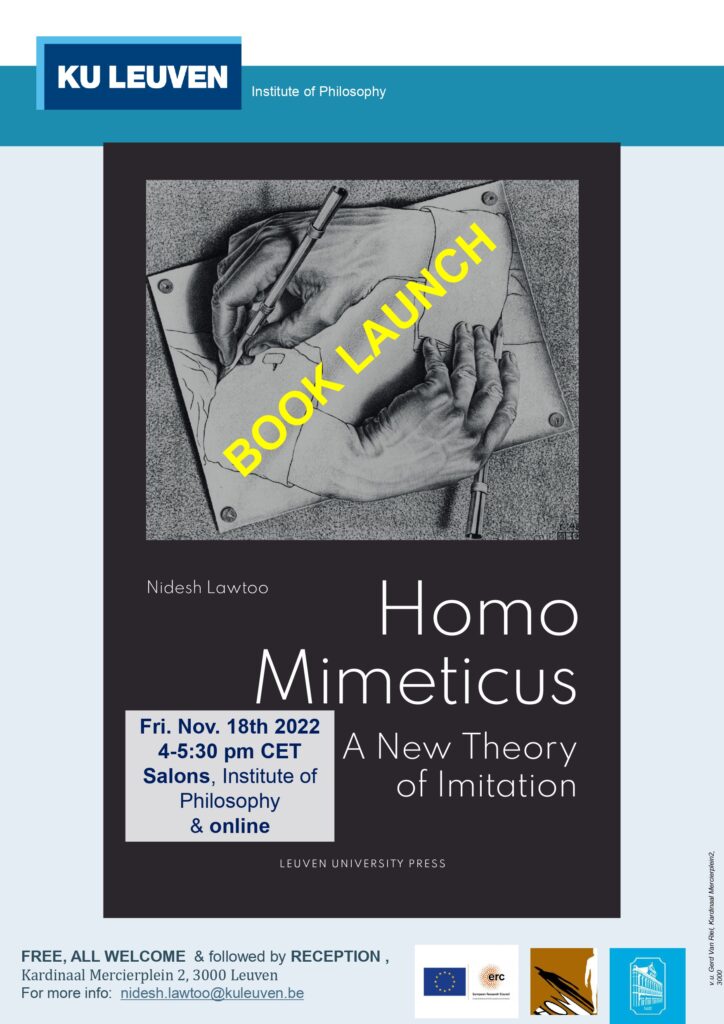
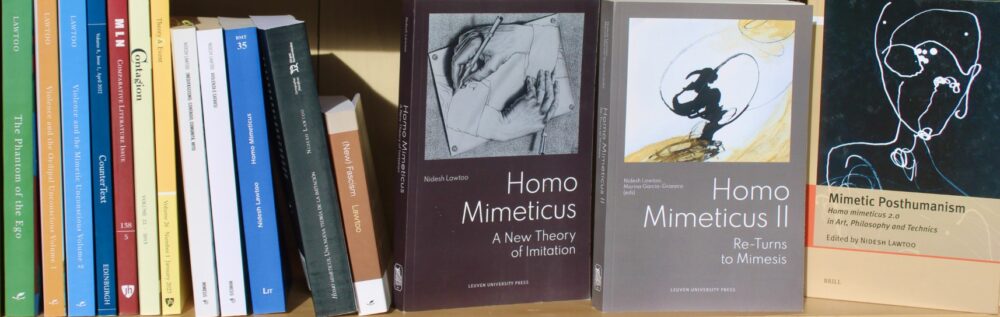
5 years ago the HOM project promised a new theory of imitation to face some of the main challenges of the present. Here it is, with Leuven UP! In this book launch, HOM/GM team members Niki Hadikoesoemo, Marina García-Granero and Giulia Rignano talk with Nidesh Lawtoo about the main insights and takeaways of Homo Mimeticus: A New Theory of Imitation (Freely available Open Access here). All are welcome, reception to follow, and on hybrid mode More information including Zoom link here.
In Keynote 1 for the Mimetic Turn, Mikkel Borch-Jacobsen reloads Plato’s critique of mimesis for the digital age by restaging the following dialogue:
Socrates : Of the many excellences which I perceive in the order of our state, there is none which upon reflection pleases me better than the rule about Internet.
Glaucon : To what do you refer ?
Socrates : To our refusal to admit the memetic kind of media, for it certainly ought not to be received … Speaking in confidence, for you will not denounce me to Facebook and the rest of the memetic networks, all memes are made to contaminate the thinking (dianoia) of the hearers, unless as an antidote (pharmakon) they possess the knowledge of the true nature of the originals.
In this public lecture for the LMU Doctoral Program on Mimesis Final Conference, Nidesh Lawtoo (KU Leuven) articulates the relevance of HOM Theory to account for the mimetic patho(-)logies in the Age of Covid-19: from affective contagion to viral contagion, conspiracy theories to therapeutic imitations, Lawtoo argues that rethinking mimesis beyond representation is central to account for the patho(-)logies of contagion in periods of pandemic crisis.
Part of a panel on Jane Bennett’s Influx & Efflux (2020) organized at Johns Hopkins University, ERC grantee Nidesh Lawtoo establishes a bridge between new materialism and mimetic theory. He argues that the influences internal to Bennett’s account of a porous self, tap into the unconscious powers of mimesis to induce sympathy towards (non)human others, along contagious lines central to the mimetic turn as well.


